A Barrel’s Journey From Crisis to Cash
A plain-English guide to why oil price chaos is actually great news for Pakistan’s refiners
It is a Tuesday morning in Lahore. You pull into a petrol station, look at the price board, and feel your stomach drop. Petrol is up Rs55 per litre compared to just weeks ago. You pay, drive off frustrated, and assume everyone in the oil business must be suffering alongside you.
Somewhere in Pakistan, a refinery’s quarterly numbers are coming in. Profits are up. Margins are expanding.
Same oil. Same price spike. Completely opposite outcomes. Here is why.
Section 1 — The Question Everyone Gets Backwards
When crude oil gets expensive, the instinct is to assume refineries suffer — after all, crude is their raw material. But refineries are not textile mills or bakeries. Their profitability has almost nothing to do with whether crude is expensive or cheap in isolation.
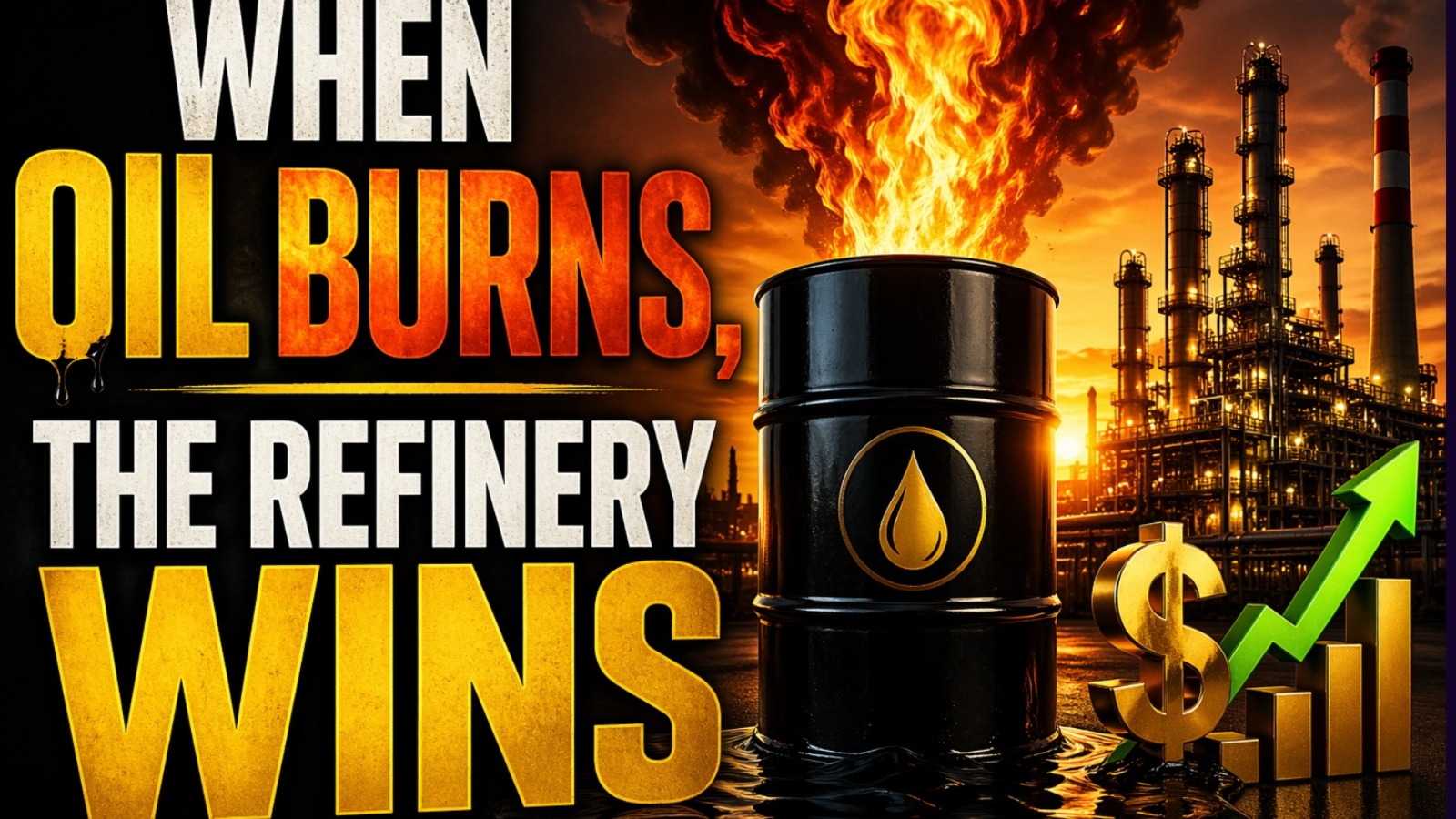
What actually matters is the gap — the difference between what a refinery pays for crude and what it earns selling refined products like petrol and diesel. That gap is called the Crack Spread — and right now, it is extraordinarily wide.
Section 2 — Meet the Crack Spread: The Only Number That Actually Matters
Think of it simply: if crude costs $66 per barrel and diesel sells for $121 per barrel, the refinery pockets a $55 spread. The historical average for that same spread is $25–$30. Refineries are currently operating at roughly double their normal margin on diesel alone.
This combined spread across all products — weighted by output — is what the industry calls the Gross Refining Margin (GRM). Pakistan’s GRMs collapsed to $4.5 per barrel in April 2025. By early 2026, they had recovered to $13.3 per barrel — nearly a two-year high.
Section 3 — Why Chaos in the Middle East Is Good News for Pakistani Refiners
The current surge in refining margins has a specific, traceable cause: a global diesel shortage.
When the US and EU imposed sanctions on Russian oil, global diesel production fell — Russian crude produces a disproportionately high share of diesel. Demand did not fall at the same rate. Diesel prices stayed elevated even as crude went bearish. The gap between them blew wide open.
Add Middle East tensions pushing up geopolitical risk premiums, and the crack spread widened further. For Pakistan’s refineries, they are buying crude at one price and selling diesel into a global market pricing it at a significant premium above historical norms.
Section 4 — Pakistan’s Import Parity Pricing: The Rule That Automatically Rewards Refiners
Since September 2020, Pakistan shifted petroleum product pricing to a fortnightly revision cycle, benchmarked to Platt’s Index — the global standard for petroleum product pricing. The ex-refinery price a local refinery receives is pegged to what it costs to import the same product.
In plain terms: when global product prices rise, local refinery revenue rises automatically. The crude cost goes up, but the selling price goes up faster. The refinery does not need to renegotiate contracts or lobby for relief. The formula does the work.
Section 5 — Pakistan’s Refineries: Who Is Where, and What Do the Numbers Say?
Pakistan has five major refineries, each with a distinct profile. Here is where each one stands based on data from early 2026.
Attock Refinery Limited (ATRL) — Rawalpindi
The only refinery operating almost entirely on domestically produced crude, sourced from local fields in the north. In March 2026, total product upliftment rose 10.9% year-on-year to 127,000 tonnes. Motor Spirit volumes grew 59.4% and HSD 31.4%. Market share recovered to 13.1%, approaching the historical average of 13.7%.
Pakistan Refinery Limited (PRL) — Karachi
A hydro-skimming refinery with a capacity of 50,000 barrels per day. Diesel accounts for approximately 50% of its product slate. In February 2026, PRL posted a 55.4% year-on-year jump in sales to 147,000 tonnes. March sales rose 23.8% YoY to 139,000 tonnes, with a 49.9% surge in motor spirit volumes.
National Refinery Limited (NRL) — Karachi
NRL holds the highest diesel exposure of any Pakistani refinery, with HSD accounting for approximately 54% of its energy product output — making it arguably the most levered to elevated diesel spreads. In February 2026, NRL posted a 51.7% year-on-year sales jump to 113,000 tonnes, with MS up 63.6% and HSD up 77.8%.
Cnergyico PK Limited — Karachi
The largest refinery in Pakistan by capacity. Cnergyico recorded the strongest volumetric recovery in early 2026. February 2026 sales surged 81.8% year-on-year to 135,000 tonnes, led by MS up 79.2%, HSD up 96.1%, and FO up 62.6%.
PARCO (Pak Arab Refinery) — Mahmood Kot, Punjab
A joint venture between the Pakistani government and Abu Dhabi National Energy Company, PARCO operates in central Punjab with a more complex refining configuration than the southern hydro-skimmers and benefits from strong inland logistics positioning.
Sector-Wide: Total refinery throughput across Pakistan rose 29% year-on-year in February 2026, driven by broad-based demand strength across MS, HSD, and furnace oil.
Section 6 — The Inventory Windfall Nobody Talks About
Refineries hold physical stockpiles of crude purchased weeks or months earlier. When oil prices rise sharply, those barrels — bought at the old, cheaper price — get refined and sold at the new, higher product prices. The refinery did nothing. It just waited. And it booked a profit purely from the price movement on its existing inventory.
This is called an inventory gain, and during sharp oil price rallies it can add meaningfully to quarterly earnings. The reverse — inventory losses — is equally brutal. In FY2015, falling crude prices triggered severe inventory losses across Pakistan’s refinery sector, with multiple refineries posting net losses despite reasonable operational activity.
Section 7 — But It Is Not All Roses
Furnace oil has become a deeply problematic product. Domestic demand has collapsed following the imposition of a carbon levy and the shift of power generation away from oil-fired plants. Furnace oil currently trades at a significant discount to crude — meaning refineries are losing money on that portion of output.
Pakistan’s refineries are also old, mostly operating on hydro-skimming technology that produces a product slate heavy in low-value furnace oil. The government’s New Refinery Policy 2023 attempts to address this through upgrade incentives, but timelines and financing remain uncertain.
Finally, Pakistan’s energy sector carries a significant circular debt overhang — amounts owed to refineries by power utilities that sit as receivables but create real cash flow stress, even in high-margin periods.
So — Who Actually Wins?
You paid more at the pump. That is real, and it hurts. But the refinery bought crude weeks ago at a lower price, is selling diesel at double its historical spread, and its selling price was automatically revised upward by a government formula benchmarked to global import parity.
Same barrel of oil. Opposite financial outcomes.
The crack spread is the story. Everything else is noise.
Sources
- Nukta — “Pakistan’s Refinery Margins Spike on Diesel Shortage”, November 2025. nukta.com/pakistans-refinery-margins-spike
- The Express Tribune — “Refinery Margins at 2-Year High on Diesel Crunch”, November 2025. tribune.com.pk/story/2578281
- Geo.tv / The News — “Refining Sector to Benefit from Higher GRMs Amid Widening Spreads”, March 2026. geo.tv/latest/656207
- News Alert Pakistan — “Pakistan’s Refining Sector Poised to Benefit From Higher Margins”, March 2026. newsalert.com.pk
- Profit by Pakistan Today — “Pakistan’s Refinery Sector Posts Robust 13% Growth in March 2026”, April 2026. profit.pakistantoday.com.pk/2026/04/03
- Profit by Pakistan Today — “Pakistan’s Refinery Margins Hit Nearly Two-Year High”, November 2025. profit.pakistantoday.com.pk/2025/11/20
- PACRA Research — “Refineries Sector Study”, December 2025. pacra.com
- Finqalab — “Oil Refining Insights: Key Challenges, Regulations, and Future Outlook”, December 2025. finqalab.com/blog/oil-refining-insights
- Business Recorder — “Pakistan Refinery Limited: Outlook and Performance”, December 2025. brecorder.com/news/40399930
The content in this article is for general information only and should not be taken as financial or investment advice. Past performance of any sector or stock is not indicative of future results. The author holds no position in any of the companies mentioned. Always consult a qualified financial advisor before investing.
.png "Beyond the Hype: How to Build a Real 2026 Portfolio in the Pakistan Market")